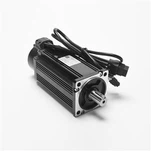
1. Accuracy: Achieved closed-loop control of position, speed, and torque; Overcoming the problem of stepping motor out of step;
2. Speed: Good high-speed performance, generally rated speed can reach 2000-3000 rpm;
3. Adaptability: Strong overload resistance, able to withstand loads three times the rated torque, especially suitable for situations with instantaneous load fluctuations and requirements for fast starting;
4. Stability: Smooth operation at low speeds, without the occurrence of stepper motor like phenomena during low speed operation. Suitable for situations with high-speed response requirements;
5. Timeliness: The dynamic response time of motor acceleration and deceleration is short, usually within a few tens of milliseconds;
6. Comfort: Fever and noise are significantly reduced.
Simply put, it means that the ordinary motor you see usually will continue to rotate for a while due to its own inertia and then stop after a power outage. And servo motors and stepper motors stop as soon as they say, and walk as soon as they say, with extremely fast reactions. But there is a phenomenon of stepping out of step in the stepper motor.
There are too many application areas for servo motors. As long as there is a power source and precision requirements, servo motors may generally be involved. Equipment with relatively high requirements for process accuracy, processing efficiency, and work reliability, such as machine tools, printing equipment, packaging equipment, textile equipment, laser processing equipment, robots, automated production lines, etc.