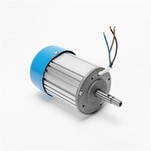
In industrial applications, the most common motor is the servo motor.
It is often used to drive the motion axis to achieve high-precision positioning.
For example, common material pick-and-place motion platforms, conveyor belts, robotic manipulators, lens focusing, etc.
Servo motors are used for picking and placing materials.
Servo motors are used for packaging.
Servo motors are used for wine bottle conveyors.
Servo motors are used in robots.
Servo motors are used for single-axis motion platforms.
According to the different classification methods of motors, there are also different types of servo motors.
1. DC Servo VS AC Servo Motor
According to the use of AC or DC drive, servo motors can be divided into AC servo motors and DC servo motors.
From a performance standpoint, the main difference between AC and DC motors is speed control.
For a DC motor, the speed is proportional to the supply voltage to a constant load, while in an AC motor, the speed is determined by the frequency of the applied voltage and the number of poles.
AC servo motors are divided into synchronous motors and asynchronous motors (induction motors). Synchronous motors contain permanent magnets. In order to increase the motor output torque or force, the usage of permanent magnets increases, so the cost is higher, and they are widely used in low power applications ( Generally not more than 10kW).
However, with the advent of high-performance permanent magnets in recent years, synchronous AC servo motors are now the default option, and in fact, some of the most common high-performance industrial servo motors are three-phase synchronous brushless AC motors.
Asynchronous motors do not use permanent magnets and are often used in higher output applications such as 10kW or more.
While both AC and DC motors are used in servo systems, AC motors can handle higher currents.
Meanwhile, in a brushless DC motor (BLDC) motor, the stator coils are trapezoidally wound and generate a trapezoidal back EMF waveform, which tends to produce audible noise, and the commutation is achieved in six steps, which creates torque ripple.
Synchronous AC motors, on the other hand, have sinusoidal winding stators and use continuous sinusoidal commutation, which eliminates the torque ripple experienced by BLDC motors.
This makes synchronous AC motors the first choice for high-performance industrial servo applications.
Such as robotics, in-line manufacturing and other industrial applications that require high repeatability and precision.
2. Brushed Servo Motor VS Brushless Servo Motor
According to the type of commutator used by the motor, servo motors can be divided into brushed servo motors and brushless servo motors.
Brushed motors are generally cheaper and simpler to operate, while brushless designs are more reliable, more efficient, and less noisy.
Brushed DC motors are further subdivided according to the structure of the stator: series, parallel, compound or permanent magnet.
While most motors used in servo systems are brushless designs, brushed permanent magnet DC motors are sometimes used as servo motors because of their simplicity and low cost.
The most common type of brushed DC motor used in servo applications is the permanent magnet DC (PMDC) motor.
Brushless DC (BLDC) motors are also used in servo systems.
Brushless DC motors replace physical brushes and commutators electronically, often using Hall-effect sensors or encoders.
A commutator is a rotary electrical switch that periodically reverses the direction of rotor current for continuous operation.
It consists of a cylinder consisting of multiple metal contact segments on the rotor that communicate current with the brushes. The brushes are made of a soft conductive material (such as carbon) and usually have two or more electrical contacts that slide into contact with the commutator as the commutator rotates, enabling the current direction to change and current to conduct.
AC motors are usually brushless, although some designs (such as general purpose motors that can run on AC or DC power) do have brushes and are mechanically commutated.
The term Brushless AC (BLAC) motors can be a bit confusing as they are also known as Permanent Magnet AC (PMAC) motors or Permanent Magnet Synchronous Motors (PMSM).
3. Synchronous Servo Motor VS Asynchronous Servo Motor
Finally, according to whether the rotating magnetic field of the motor and the rotor are synchronized, it is divided into synchronous motor and asynchronous motor.
While DC motors are often classified as brushed or brushless, AC motors are more frequently differentiated based on the speed of their rotating magnetic field, i.e. synchronous or asynchronous.
In an AC motor, the speed is determined by the frequency of the supply voltage and the number of poles, and this speed is called synchronous speed.
In a synchronous motor, the rotor rotates at the same speed as the stator's rotating magnetic field.
In an asynchronous motor (often called an induction motor), the rotor rotates at a slower speed than the stator's rotating magnetic field.
When an induction motor is paired with a variable frequency drive, speed control and performance similar to a servo motor can be achieved, but because they usually do not contain feedback, they are not true servo devices.
4. Characteristics of Servo Motors
Servo motors are able to operate over a wide range of speeds, including high and low speeds, without overheating, and maintain enough torque at zero speed to hold the load in place.
They also maintain a constant speed despite changes in the amount of torque acting on the system.
Peak torque is the maximum torque a motor can produce for a short period of time, while continuous torque can be produced indefinitely.
If a servo motor is operated above its continuous rated torque for an extended period of time, it will generate too much heat, which can damage the motor's circuitry.
Running above its peak torque, the servo motor may demagnetize the magnets.