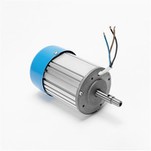
Servo motor (servomotor) refers to the engine that controls the operation of mechanical components in the servo system, and is an auxiliary motor indirect transmission device. The servo motor can control the speed and position accuracy very accurately, and can convert the voltage signal into torque and speed to drive the control object.
The rotor speed of the servo motor is controlled by the input signal and can respond quickly. In the automatic control system, it is used as an actuator, and has the characteristics of small electromechanical time constant, high linearity, and starting voltage, which can convert the received electrical signal. Converted to angular displacement or angular velocity output on the motor shaft.
Classification: DC Servo Motors and AC Servo Motors.
DC servo motors are divided into brushed and brushless motors. The brushed motor has low cost, simple structure, large starting torque, wide speed regulation range, easy control, and requires maintenance, but it is easy to maintain (replacement of carbon brushes), generates electromagnetic interference, and has requirements for the environment. Therefore, it can be used in cost-sensitive general industrial and civil applications.
The brushless motor is small in size, light in weight, large in output, fast in response, high in speed, small in inertia, smooth in rotation and stable in torque. The control is complex, and it is easy to realize intelligentization. Its electronic commutation mode is flexible, and it can be square wave commutation or sine wave commutation. The motor is maintenance-free, has high efficiency, low operating temperature, small electromagnetic radiation, long life, and can be used in various environments.
AC servo motors are also brushless motors, which are divided into synchronous and asynchronous motors. At present, synchronous motors are generally used in motion control. They have a large power range and can achieve great power. Large inertia, high rotational speed is low, and decreases rapidly with increasing power. Therefore, it is suitable for applications that operate smoothly at low speeds.
The rotor inside the servo motor is a permanent magnet. The U/V/W three-phase electricity controlled by the driver forms an electromagnetic field. The rotor rotates under the action of this magnetic field. At the same time, the encoder that comes with the motor feeds back the signal to the driver. Values are compared, and the angle of rotation of the rotor is adjusted. The accuracy of the servo motor is determined by the accuracy (number of lines) of the encoder.
What is a servo motor? How many types are there? What are the characteristics of the work?
Answer: The servo motor is also called the executive motor. In the automatic control system, it is used as the executive element to convert the received electrical signal into the angular displacement or angular velocity output on the motor shaft. It is divided into two categories: DC and AC servo motors. Its main feature is that when the signal voltage is zero, there is no self-rotation phenomenon, and the speed decreases uniformly with the increase of torque.
What is the functional difference between an AC servo motor and a brushless DC servo motor?
Answer: AC servo is better, because it is controlled by sine wave, and the torque ripple is small. DC servos are trapezoidal waves. But DC servo is simpler and cheaper.
Permanent Magnet AC Servo Motor
Since the 1980s, with the development of integrated circuits, power electronics technology and AC variable speed drive technology, permanent magnet AC servo drive technology has achieved outstanding development. Famous electrical manufacturers in various countries have successively launched their own AC servo motors and servo driver series. Products are continuously improved and updated.
The AC servo system has become the main development direction of the contemporary high-performance servo system, which makes the original DC servo face the crisis of being eliminated. After the 1990s, the AC servo system that has been commercialized in various countries in the world is driven by a sine wave motor servo drive with full digital control.
The development of AC servo drives in the field of transmission is changing with each passing day. Compared with the DC servo motor, the permanent magnet AC servo motor has the following main advantages:
(1) There are no brushes and commutators, so the work is reliable and the maintenance and maintenance requirements are low.
(2) It is more convenient for stator winding to dissipate heat.
(3) The inertia is small, and it is easy to improve the rapidity of the system.
⑷ It is suitable for high-speed and high-torque working conditions.
⑸ It has smaller volume and weight under the same power.