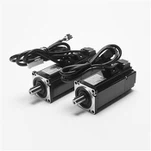
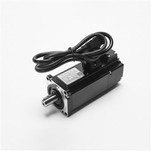
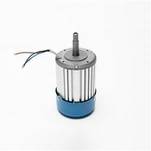
The general structure of the electric servo system is three closed-loop controls, namely the current loop, the speed loop and the position loop. In general, for AC servo drives, various functions such as position control, speed control, and torque control can be realized by manually setting their internal function parameters. So what do you need to know about servo motors?
1. How to choose servo motor and stepper motor correctly?
Answer: It mainly depends on the specific application. In short, it is necessary to determine: the nature of the load (such as horizontal or vertical load, etc.), the requirements for torque, inertia, speed, accuracy, acceleration and deceleration, and the requirements for upper control (such as the port interface and communication requirements), the main control mode is position, torque or speed mode. Whether the power supply is DC or AC power, or battery powered, voltage range. Based on this, determine the model of the motor and the associated drive or controller.
2. Choose a stepper motor or a servo motor system?
Answer: In fact, what kind of motor to choose should be determined according to the specific application, and each has its own characteristics.
3. How to use the stepper motor driver?
Answer: According to the current of the motor, use a driver that is greater than or equal to this current. If low vibration or high precision is required, a subdivision driver can be used. For high-torque motors, use high-voltage drives as much as possible to obtain good high-speed performance.
4. What is the difference between 2-phase and 5-phase stepper motors and how to choose?
Answer: 2-phase motor has low cost, but the vibration is large at low speed, and the torque drops quickly at high speed. The 5-phase motor has less vibration and good high-speed performance, which is 30~50% higher than the speed of the 2-phase motor, and can replace the servo motor in some occasions.
5. When to choose DC servo system, what is the difference between it and AC servo?
Answer: DC servo motors are divided into brushed and brushless motors.
The brushed motor has low cost, simple structure, large starting torque, wide speed regulation range, easy control, and requires maintenance, but it is easy to maintain (replacement of carbon brushes), generates electromagnetic interference, and has requirements for the environment. Therefore, it can be used in cost-sensitive general industrial and civil applications.
The brushless motor is small in size, light in weight, large in output, fast in response, high in speed, small in inertia, smooth in rotation and stable in torque. The control is complex, and it is easy to realize intelligentization. Its electronic commutation mode is flexible, and it can be square wave commutation or sine wave commutation. The motor is maintenance-free, has high efficiency, low operating temperature, small electromagnetic radiation, long life, and can be used in various environments.
AC servo motors are also brushless motors, which are divided into synchronous and asynchronous motors. At present, synchronous motors are generally used in motion control. They have a large power range and can achieve great power. High inertia, low maximum rotational speed, and decreases rapidly with increasing power. Therefore, it is suitable for applications that operate smoothly at low speeds.
6. What should be paid attention to when using the motor?
A: Check the following before powering on and running:
1) Whether the power supply voltage is appropriate (overvoltage may cause damage to the drive module); the +/- polarities of the DC input must not be wrongly connected, and whether the motor model or current setting value on the drive controller is appropriate (do not too large);
2) The control signal line is firmly connected, and it is best to consider the shielding problem in the industrial site (such as using twisted pair);
3) Don't connect all the lines that need to be connected at the beginning, only connect to the most basic system, and then connect gradually after running well.
4) Be sure to figure out the grounding method, or use the floating method.
5) Closely observe the state of the motor within half an hour of starting operation, such as whether the movement is normal, the sound and temperature rise, and immediately stop and adjust if any problem is found.
7. The stepper motor sometimes loses steps when it starts running. What is the problem?
When the incoming motor starts to run, it sometimes stops moving or moves back and forth in place, and sometimes loses steps during operation. Generally, the following aspects should be considered for inspection:
1) Whether the motor torque is large enough to drive the load, so we generally recommend that users choose a motor with a torque that is 50%~100% larger than the actual need when selecting models, because the stepping motor cannot be overloaded, even for a moment. Cause loss of step, stop or move irregularly in place in severe cases.
2) Whether the current of the input walking pulse from the host controller is large enough (usually >10mA) to make the optocoupler turn on stably, and whether the input frequency is too high, so that it cannot be received, if the output circuit of the host controller If it is a CMOS circuit, a CMOS input type driver should also be used.
3) Whether the starting frequency is too high, and whether the acceleration process is set on the starting program, it is best to start accelerating from the starting frequency specified by the motor to the set frequency, even if the acceleration time is very short, otherwise it may be unstable or even in an inert state .
4) When the motor is not fixed, this situation sometimes occurs, which is normal. Because, in fact, the strong resonance of the motor is caused at this time, which leads to the out-of-step state. The motor must be fixed.
5) For a 5-phase motor, if the phase is wrongly connected, the motor will not work.
8. I want to directly control the servo motor through communication, is that possible?
Yes, and it is more convenient, but it is only a matter of speed, and it is used for applications that do not require very high response speed. If fast response to control parameters is required, it is best to use a servo motion control card, which generally has DSP and high-speed logic processing circuits to achieve high-speed and high-precision motion control. Such as S acceleration, multi-axis interpolation, etc.
9. Is it good to use switching power supply to power stepper and DC motor system?
It is generally best not to, especially for high-torque motors, unless a switching power supply with more than twice the required power is used. Because the motor is a large inductive load when it is working, it will form an instantaneous high voltage on the power supply end. The overload performance of the switching power supply is not good, it will protect the shutdown, and its precise voltage regulation performance is not required, which may sometimes cause damage to the switching power supply and the driver. A DC power source that can be transformed with a conventional toroidal or R-type transformer.
10. Is it possible to control the stepper motor with a DC voltage of ±10V or 4~20mA?
Yes, but requires an additional conversion module.