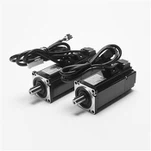
The structure of AC servo motor is similar to that of single-phase asynchronous motor. Two-phase windings with a space difference of 90° are placed in the stator iron core. One phase is called the excitation winding, and the other is called the control winding. When the motor is working, the excitation winding is connected to the single-phase AC voltage, and the control winding is connected to the control signal voltage, and the two-phase voltages are required to have the same frequency.
The rotor of the AC servo motor has two structural forms. One is the squirrel-cage rotor, which is similar to the squirrel-cage rotor of an ordinary three-phase asynchronous motor, except that it is more slender in shape, thereby reducing the rotor's moment of inertia and the electromechanical time constant of the motor. The cage rotor AC servo motor has a large volume, a small air gap, a small excitation current required, a high power factor, and a high mechanical strength of the motor, but the fast response performance is slightly poor, and the low-speed operation is not stable enough.
The other is a non-magnetic hollow cup-shaped rotor. The rotor is made of a cup-shaped structure. In order to reduce the air gap, there is an inner stator in the cup-shaped rotor. Made of aluminum or aluminum alloy, the wall thickness of the cup is 0.2~0.8mm, the moment of inertia is small, and it has a large resistance. The hollow cup rotor AC servo motor has the advantages of fast response and stable operation, but the structure is complex, the air gap is large, the load current is large, and the power factor is low.