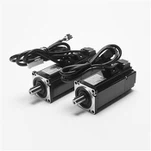
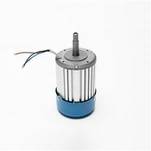
In the AC servo motor, in addition to the requirement that the motor cannot "rotate", it is also required to change the magnitude and phase of the voltage applied to the control winding to change the magnitude and direction of the motor speed.
According to the theory of rotating magnetomotive force, the excitation winding and the control winding work together to generate a rotating magnetic field, and the rotation direction of the rotating magnetic field is from the phase-advanced winding to the phase-lag winding. Changing the phase of the control voltage in the control winding can change the lead-lag relationship of the two-phase winding, thereby changing the rotation direction of the rotating magnetic field, and the direction of the AC servo motor speed will also change. Changing the size and phase of the control voltage can change the magnetic flux of the rotating magnetic field, thereby changing the electromagnetic torque of the motor, and the speed of the AC servo motor will also change.