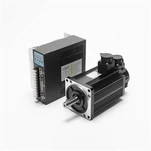
Products Description
How to define servo motor?
A servo motor is a type of electric motor that is used for precise control and positioning of a shaft. It typically consists of a motor, a gear train, a control circuit, and a position feedback mechanism. The motor rotates the shaft to a specific angular position, which is determined by the control signal received by the control circuit. The position feedback mechanism, such as a potentiometer, provides information on the actual position of the shaft, which the control circuit uses to make adjustments to the motor to maintain the desired position. Servo motors are commonly used in applications that require precise control and positioning, such as robotics, automation, and control systems.
Specifications:
|
Flange |
SQ-1 |
Rated Voltage (V) |
Rated Power (KW) |
Rated Torque (N.m) |
Rated Current(A) |
Rated Speed (rpm) |
|
180 |
180A6ST-M18615 |
380 |
2.9 |
18.6 |
10.0 |
1500 |
|
180A6ST-M28415 |
380 |
4.4 |
28.4 |
14.5 |
1500 |
|
|
180A6ST-M35015 |
380 |
5.5 |
35 |
17.6 |
1500 |
|
|
180A6ST-M48015 |
380 |
7.5 |
48 |
23 |
1500 |


Advantages:
Which is better stepper or servo?
The choice between a stepper motor and a servo motor depends on the specific requirements of the application. Both stepper motors and servo motors have their own advantages and disadvantages, and the best choice will depend on the specific needs of the application.
Stepper motors are known for their precise control and high holding torque, making them well suited for applications that require precise positioning and control. They are commonly used in applications that require the motor to move to specific positions, such as in printers and computer-controlled milling machines.
Servo motors, on the other hand, are capable of both precise positioning and continuous rotation, making them suitable for a wider range of applications. Servo motors are often used in applications that require precise control of the position of a shaft, such as in robotics and industrial automation.
In general, stepper motors are more cost-effective than servo motors and are typically simpler to control, while servo motors offer greater precision and speed. The best choice between a stepper motor and a servo motor will depend on the specific requirements of the application, such as the required level of precision, speed, and cost.

Applications:
The application of servo motors in CNC (Computer Numerical Control) machines is widespread, as they provide precise control and positioning capabilities that are ideal for CNC applications. Here are some of the most common applications of servo motors in CNC machines:
Axis control: Servo motors are commonly used to control the movement of the various axes (X, Y, Z, etc.) in CNC machines. They provide precise control over the position and speed of the axes, allowing for accurate cutting and positioning of the machine tool.
Spindle control: Servo motors are also used to control the speed and positioning of the spindle in CNC machines. This allows for precise control of the cutting speed, depth, and angle of the tool, which is essential for producing high-quality parts.


Certificates:

Exhibitions:


Why choose us?

FQA:
Q:What's about your technology ability?
A:We have our own R&D team, can provide one-stop solution for your application.
Q: How does your factory do regarding quality control?
A: Quality is priority. We always attach great importance to quality control from the beginning to the end of the production.
Every product will be fully assembled and carefully tested before packed.
Q:What's your warranty terms?
A: We offer different warranty terms for different products. Please contact with us for details.