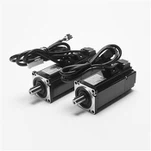
AC motors include AC synchronous motors and AC induction motors. Induction motors are also called AC asynchronous motors. Induction motor is the most widely used type of motor. Its stator and rotor rely on electromagnetic induction, which is similar to the principle of transformer. It induces current in the rotor and ultimately realizes electromechanical energy conversion.
The rotor of the induction squirrel cage motor is a self closing cage type guide bar structure, so it is also called a cage type motor. The rotor winding of the cage induction motor is electrically short circuited and is not connected to the outside. The rotor current is induced from the stator winding through the transformer principle. The rotor of an induction motor is no longer excited by an external power source, but induces rotor current in the short-circuit rotor winding as the rotor slides through the armature magnetic flux wave rotating synchronously. From the actual structural analysis of connecting all the guide bars at both ends of the cage rotor, the rotor can be decomposed into multiple closed loops to complete rotation under the rotating magnetic field; Due to the particularity of its rotor structure, the motor can also realize pole changing speed regulation, that is, the motor speed can be changed by changing the number of poles of the stator winding without changing the rotor.
The rotor of the wound type induction motor is more complex than the cage type rotor. The rotor slot of the wound type three-phase induction motor is embedded with windings, and the three outgoing terminals of the windings are soft connected through a carbon brush system. Theoretically, when the rotor is in the open circuit state, the motor cannot rotate. Only after the three-phase windings are short circuited can the motor operate normally. However, compared with the cage induction motor, the number of poles of the motor rotor is unique and cannot be changed according to the number of poles of the stator. The characteristic of this kind of rotor is that external resistance can be connected to the rotor winding to improve the starting and speed regulation performance of the motor. It can be used in occasions requiring small starting current, large starting torque or less accurate speed regulation.
However, with the development of variable frequency motor, the market of this kind of motor has been greatly affected, and in some special occasions, this motor still has its unshakable position.