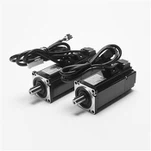
Control accuracy: the more phases and beats of the stepper motor, the higher its accuracy, the servo motor takes the block from the built-in encoder, the more scales of the encoder, the higher the accuracy;
Low-frequency characteristics: The stepper motor is prone to low-frequency vibration at low speed. When it works at low speed, damping technology or subdivision technology is generally used to overcome the low-frequency vibration phenomenon. The servo motor runs very smoothly and does not vibrate even at low speed. Phenomenon;
Torque-frequency characteristics: the output torque of the stepper motor decreases with the increase of the speed, and it drops sharply at high speed. The servo motor has a constant torque output within the rated speed and constant power output at the rated speed;
Overload capacity: Stepper motors do not have overload capacity, and servo motors have strong overload capacity;
Running performance: The control of the stepper motor is open-loop control. If the starting frequency is too high or the load is too large, it is easy to lose steps or stall. When the speed is too high, it is easy to cause overshoot. The AC servo drive system is closed-loop control. The feedback signal of the motor encoder can be directly sampled, and a position loop and a speed loop are formed internally. Generally, the phenomenon of step loss or overshoot of the stepping motor does not occur, and the control performance is more reliable.